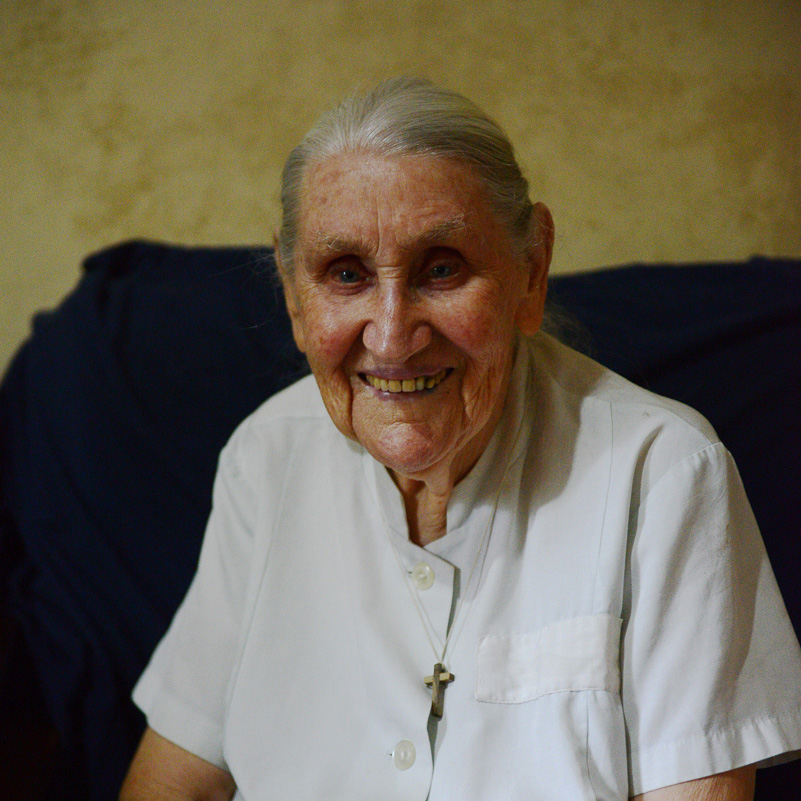
Sister Therese

A friend wrote me a message, telling me about a German lady, who lives in Africa since decades as a nun and founded several dispensaries. If i’m passing by that area i should visit her, he suggested. And indeed, it seemed i’m pretty close there anyway.

On my way i got stopped by the traffic police. Once more. While the officer check my papers he wanted to know where i’m heading to. I told him the story of the old lady, doing so many good things for local people. I admire to meet her and maybe making some photos of the place she founded, i explained. As the officer has seen my camera he wanted me to do a portrait shot of himself. I did. With a smile on both of us he let me go.

Just ask for ‚Sister Therese‘ when you reach the town, my friend advised me. And indeed, even the people on the street didn’t recognized the name of the dispensary, they reacted promptly on the name of the nun. But Sister Therese doesn’t live here anymore. The new chairman of the small hospital organized a nice chap who’s guiding me to the new founded dispensary of Sister Therese. It was about an hour drive or so. Maurice asked me to stop in a village to introduce me with the chief, who owns a shop. It’s all interesting and so much to learn about, but also time consuming. Finally we reached the dispensary and i met Sister Therese in person. After a brief tour trough the building and nearby garden, she told me her story by a soup and tea. Since she was a young girl she wanted go somewhere far. As a young nun she went to Southern Africa, studied to become a nurse and stayed many years in Zimbabwe. Many stories about trouble and terrible times, in Southern and later in Eastern Africa, but also about never ending hope and times of happiness. Her eyes are always smiling even when she’s telling dark stories. A truly strong woman, which i’d like to spend more time with, but it got late and time to leave for me. Despite the short time with her, it let a deep impression on my way out of the bush.

Moyo’s Refugee Camps

There’s a beautiful landscape far north of Uganda, just at the border to South Sudan, i read. Off i go, and many bumpy kilometers later i reached Moyo, a dusty border town. Dozens of big, white Toyotas and trucks with blue UN letters or red crosses crossing my way. It’s not a sleepy town anymore since thousands of Sudanese refugees fleeing from the war and passing trough here. I stopped for a bitter lemon at a bar, watching busses with refugees coming from reception camps, get somewhere out of town. Young men hanging around, drinking cheap liquor from small plastic bags. I need a tourist camp to stay overnight, i tell them. Helpfully they explain me the way, spell the name of a place and show me the spot on the map. Just at the river Nile. Looks great to me. When i arrived the place it turns out as huge refugee camp. It’s too late to turn back, so i ask around for a real „tourist camp/lodge“. Another friendly guy shows the direction, just to end up in another refugee camp, even further away from next town. I felt lucky to see a bunch of big, expensive Toyotas with the emblem of a NGO. I asked friendly to stay at the carpark, where a guard is watching at night anyway. A young white guy called himself in charge, but refused to take any responsibility and sent me away. When i turned for another help, he gave me the advice to ask the neighbors, but offer them some money for their help. „sure“, i smiled to him, but thought ‚fuck you off with your cheap advices while too cowardly to let me even stay here, you white prick‘.

The locals were more helpful, sent me to the police station midst of a refugee camp. In front of a few round houses some police officers were sitting in plain clothes. After i got the allowance to stay, i sat with them and listen to their stories. The current camp opened only three months again. Every day hundreds of more refugees are coming, flooding the camps and plans for extending the area already existing. While we spoke, some armed officers arrived in uniforms, turned back from their patrol by motorbikes.  In one of the round houses the prisoners are kept until there’s a transport to Moyo to the bigger jail. Some of them move relatively free, others were with hand chains. They get out of the house to help carrying water or doing some minor jobs. When night falls over the camp, all went silent. No light, no noise. I felt like sleeping in a completely remote area.

Project; Give Girls A Future

One of the manager told us the entire history of that project. While my friend wrote it down, i got briefly the purpose of it. To get the girls from the street, out of drugs and their struggle in life, teach them a profession and help them to find a job. Tailoring is a good way. Just recently another seven girls from the project found a job in a big tailor factory, he told us. The office is occupied by 6 persons, busy at their desks. Colorful fabrics and and finished bags are lying around.

We are led around the building which stands just at edge of a slum. In there upper levels are the rooms for education, a library and the sewing machines. Next to famous brands like Singer stands machines from China. No matter, as long they do their work. Three women were busy and explained how they produce washable sanitary pads. Good idea to produce something reusable, but despite they’re convinced it’s easy to clean them properly, i still doubt it since they use to wash with cold water.

On roof top young women with their children just finished lunch.The kids were playful, posed for photos and some older ones wanted try themselves to take pictures. A couple boys gathered in a corner to play cards. When get down again, a dance class just started in one of the rooms. With the rhythm in our ears we leave the place.

Visiting Daressalam

Soon as i found a nice camp on southern beach of Daressalam i met new interesting people too. Some travelers i met before on my trip trough Africa or i made new acquaintances, with whom i went to city of Daressalam. There are some touristic spots with art and handicrafts, a national museum with old presidential vehicles and streets with shopping centers, hotels and good Indian restaurants.

Most impressive was the new build „Human Dreams Children Village“ south of the city. The people taking disabled kids to give them not only a home but also treatment for their difficulties. Among many projects in Africa, with this one, at least a few human beings with no chance for future got a place to survive and experience a worthy life.

home of good hope

Guiding my mom and her husband trough Namibia, i didn’t only want show the touristic spots of the country, but also bring them closer to real life. A soup kitchen project in Katatura/Windhoek supported by my friend Barbara, was a good start.

In the „Home Of Good Hope“ approx. 600 children daily get food, explains Monica, the founder of project. When we arrived groups of children, some in school uniforms, waited in front of the house from corrugated iron sheets. Under the eyes of helpers the kids washed their hands in bucket filled with soapy water before entering the big gloomy room.  Inside wooden banks were provided, sorted in rows like in a church. Monica and her few helpers clapped in their hands and started to sind church songs with the kids, doing little daces with them, cheering them up to praise the lord, although there is no differences made by religions of the kids coming in. The only difference is made by school kids, who gets served first because the have to be in school on time. Four Swedish girls came in to help serving the simple, but  nourishing meal. They’re in Windhoek as exchange from nursing school and volunteering the soup kitchen today. In front of the building was a table with watery juice and apples cut in small pieces.

We brought from children clothes from home. Immediately they were sorted and given to kids attending this morning the soup kitchen. Some wear it with proud when the left the building. Amongst other things i discovered boxes for first aids, and indeed, a boy came with a wound on his leg. One of the helper cleaned the wound, put desinfection fluid on it and covered it. All in completely routine. Still all the laughter in our ears we left that place with good impressions.